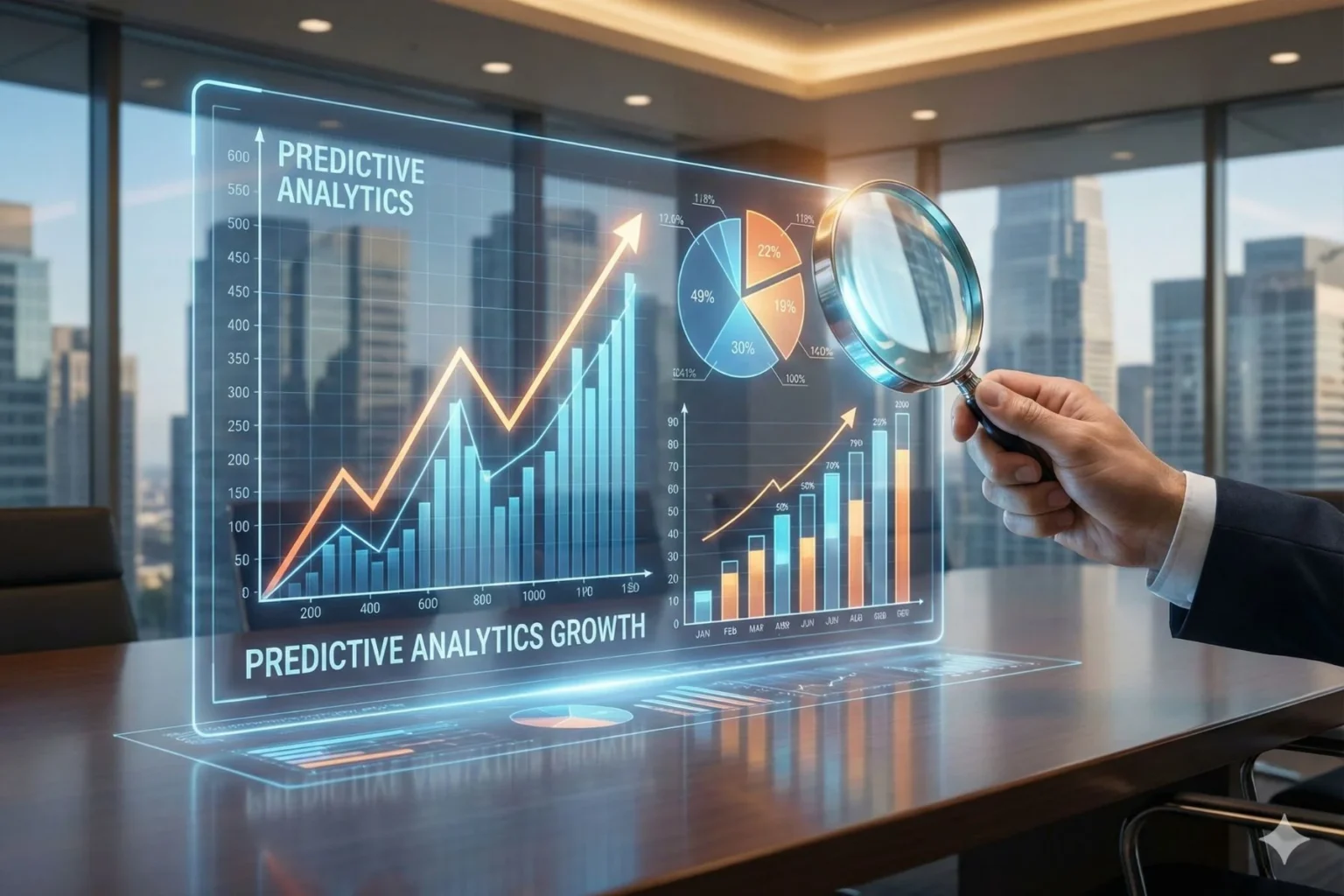
This publication is written from the front lines of growth marketing. As a growth marketer, don’t look at what happened last month to decide what to do tomorrow. Look at what the data says is about to happen. This is the shift toward Predictive Analytics Growth, and it is the only way to maintain a competitive edge in 2026.
The Shift from Reactive to Proactive Growth
Most companies scale by looking in the rearview mirror. They check their dashboard, see that churn went up by 5% in December, and then hold a meeting in January to figure out why. By the time they have an answer, it is February, and they have already lost another batch of customers. This is reactive marketing, and in a high – speed digital economy, it is a recipe for a plateau.
Predictive Analytics Growth is the practice of using historical data patterns to forecast future outcomes. Instead of asking “What happened?”, we ask “What is likely to happen next?” This allows a growth hacker to move from defensive maneuvers to offensive strategies. We aren’t just responding to the market – we are anticipating it.
In 2026, the volume of data available to even small businesses is massive. The challenge is no longer collecting data; it is turning that data into foresight. According to industry reports from firms like Gartner, companies that successfully implement predictive modeling are seeing a significant lift in marketing efficiency, often reducing wasted spend by over 30% while increasing conversion rates.

The Mechanics of Predictive Analytics Growth in 2026
To understand Predictive Analytics Growth, we have to look under the hood. It isn’t a single tool; it is a framework of machine learning algorithms and data hygiene practices.
Data Hygiene and Integration
You cannot predict the future with messy data from the past. The first step in any Predictive Analytics Growth initiative is creating a “Single Source of Truth.” This means integrating your CRM, website analytics, customer support logs, and even social sentiment into one unified layer. If your data is siloed, your predictions will be skewed. We focus on “Data Hygiene” because even the most advanced machine learning algorithms will fail if they are fed duplicate or incomplete records.
Machine Learning Algorithms
At the core of Predictive Analytics Growth are several types of models:
- Regression Analysis: Used to predict a specific value, like how much a customer will spend over the next six months.
- Classification Models: Used to put customers into groups, such as “Likely to Churn” or “High Intent.”
- Time Series Forecasting: Used to predict market trends and seasonal shifts before they occur.
In 2026, these tools have become more accessible through no – code platforms, but the strategy remains the same: identify the “signals” in the noise. For instance, a customer who visits the “unsubscription” help page and also stops using your mobile app is a clear “classification” for churn. Predictive Analytics Growth identifies this pattern long before the user actually cancels.
Scaling ROI with Predictive Analytics Growth Strategies
The primary goal of any premium agency is to maximize the Return on Investment (ROI). Predictive Analytics Growth allows us to do this by optimizing two critical areas: Lead Propensity and Customer Lifetime Value (CLV).
Lead Propensity Scoring
Stop treating every lead the same. Traditional lead scoring is often arbitrary – giving a user 10 points for opening an email. Predictive Analytics Growth uses lead propensity scoring to analyze hundreds of variables. It compares a new lead to the profile of your most successful existing customers. If the data shows that a lead from a specific industry using a specific tech stack is 80% more likely to close, your sales team should call them first. This precision targeting is how you scale without ballooning your Customer Acquisition Cost (CAC).
CLV Forecasting
Growth isn’t just about getting new customers; it’s about finding the right ones. By using Predictive Analytics Growth to forecast Customer Lifetime Value, we can determine exactly how much we can afford to spend to acquire a specific user. If we know a certain segment of users has a predicted CLV of $5,000, we can outbid competitors who only see the initial $50 transaction. This allows for aggressive, data – backed scaling that competitors simply cannot match because they lack the foresight.
Solving the Churn Crisis through Predictive Analytics Growth
Churn is the “leaky bucket” that kills growth. Most retention strategies are “too little, too late.” With Predictive Analytics Growth, we identify the “Churn Signature.”
Every customer who leaves usually leaves a trail of breadcrumbs. This might include a decrease in login frequency, a drop in feature usage, or a specific type of interaction with customer support. By feeding this historical data into a predictive model, we can assign a “Risk Score” to every current user.
When a user’s risk score crosses a certain threshold, the Predictive Analytics Growth engine triggers an automated, human – sounding intervention. This isn’t a generic “Please don’t go” email. It might be a personal outreach from a success manager or a targeted piece of content that helps them solve the exact problem they are struggling with. Data shows that proactive interventions based on these predictive signals can reduce churn by as much as 35%, directly impacting the bottom line.
Predictive SEO: The New Frontier
Search Engine Optimization (SEO) has historically been a reactive game. You see what is trending, and you write about it. Predictive Analytics Growth flips this script.
By analyzing keyword trajectory and semantic search patterns, we can identify “Emerging Entities.” These are topics that are currently low in volume but are growing at an exponential rate. By creating high – authority content on these topics now, you build “Topical Authority” before the market becomes saturated.
In 2026, search engines like Google use NLP (Natural Language Processing) to understand the intent and expertise of a writer. Predictive Analytics Growth helps us align our content strategy with where the search intent is heading. If we can predict that “Algorithmic Bias in SaaS” will be a major concern in six months, we can establish ourselves as the go – to authority today. This is how you win “Position Zero” and stay there.
Tech Stack Powering Predictive Analytics Growth
You don’t need a PhD in data science to start using Predictive Analytics Growth. The 2026 tech stack is built for marketers who need to move fast.
- Customer Data Platforms (CDPs): Tools like Segment or Tealium act as the foundation, gathering data from every touchpoint.
- Predictive Modeling Layers: Platforms like Pecan.ai or Graphite Note allow growth hackers to build models without writing code.
- Activation Layers: Your CRM (Salesforce, HubSpot) and Marketing Automation tools (Klaviyo, Braze) must be able to ingest predictive scores and trigger actions in real – time.
The integration of these tools creates a feedback loop. Every action taken by a customer is fed back into the model, making the Predictive Analytics Growth engine smarter and more accurate every single day.
Implementing Predictive Analytics Growth: Your 90-Day Roadmap
If you are ready to move from guessing to knowing, here is the framework we use to deploy Predictive Analytics Growth for our clients.
Days 1 – 30: The Foundation
Focus on data auditing. Identify where your customer data is stored and ensure it is flowing into a centralized system. Clean up duplicate records and fill in missing fields. You cannot build a house on a shaky foundation, and you cannot build a Predictive Analytics Growth strategy on bad data.
Days 31 – 60: The Pilot Model
Pick one specific problem to solve. We usually recommend starting with either churn prediction or lead scoring. Build a model using your last 12 – 24 months of data. Test the model’s accuracy by seeing if it would have correctly predicted the outcomes of the last three months.
Days 61 – 90: The Activation Phase
Once your model is at least 80% accurate, start using the scores to drive real – world actions. Give the sales team the “High Propensity” leads. Send the “High Risk” churn customers a special offer. Measure the results and refine the model. This is the stage where Predictive Analytics Growth starts to pay for itself.
Conclusion
The era of “best guesses” in marketing is over. As a growth hacker, your value is no longer just in your creativity, but in your ability to harness data to see around corners. Predictive Analytics Growth is the bridge between where your company is now and where it wants to be. By anticipating customer needs, identifying trends before they peak, and stopping churn before it happens, you aren’t just growing – you are dominating.
The most successful brands of 2026 are already using these models. They aren’t smarter than you; they just have a better view of the future. It’s time to start building your own Predictive Analytics Growth engine.
Ready to grow and push for more data backed results? Sign up for GROWTH SIGNAL NEWSLETTER where we publish data backed insights into Growth for Founders like you.
Frequently Asked Questions about Predictive Analytics Growth
Does Predictive Analytics Growth require a massive amount of data?
While more data generally leads to better models, you don’t need millions of records to start. Even a few hundred high – quality customer conversion points can be enough to start identifying meaningful patterns for Predictive Analytics Growth.
How does this differ from standard AI marketing?
Most AI marketing is generative – it helps you write or create. Predictive Analytics Growth is analytical – it helps you decide what to create and who to send it to. It is the brain, while generative AI is the hands.
Is Predictive Analytics Growth expensive to maintain?
The initial setup requires an investment in time and tools, but the long – term cost is often lower than traditional marketing because it reduces waste. You stop spending money on the wrong leads and the wrong keywords.
Can small teams execute a Predictive Analytics Growth strategy?
Yes. In 2026, many tools offer automated modeling that does the heavy lifting for you. A small, agile growth team can outperform a large, slow department by using these tools to make better decisions faster.