The era of “set it and forget it” ads is over. For years, growth was a game of arbitrage – you could buy cheap traffic on Facebook or Google, feed their algorithms some basic data, and watch the customers roll in. But the landscape has shifted. Between Apple’s privacy changes and the phase-out of third-party cookies, the “black box” of social media targeting has lost its edge.
Today, customer acquisition is less about who has the biggest budget and more about who has the best data. If you’re still trying to reach “everyone,” you’re likely watching your Customer Acquisition Cost (CAC) skyrocket. Recent market data shows that across nearly every industry, CAC has jumped by about 50% in the last two years. This isn’t just a trend; it’s the new baseline.
To grow, you have to stop thinking like a traditional advertiser and start thinking like a data scientist. You need to leverage first-party data – the information users actually give you – to find people based on their intent, not just their age or location.
What is Customer Acquisition?
In its simplest form, customer acquisition is the process of bringing new customers or clients to your business. It is the tactical bridge between someone having no idea who you are and that same person making their first purchase.

While many people mistake it for just “marketing” or “advertising,” it is actually a specific, data-driven discipline that focuses on the cost of winning a customer versus the value they bring to your company.
How the Acquisition Process Actually Works
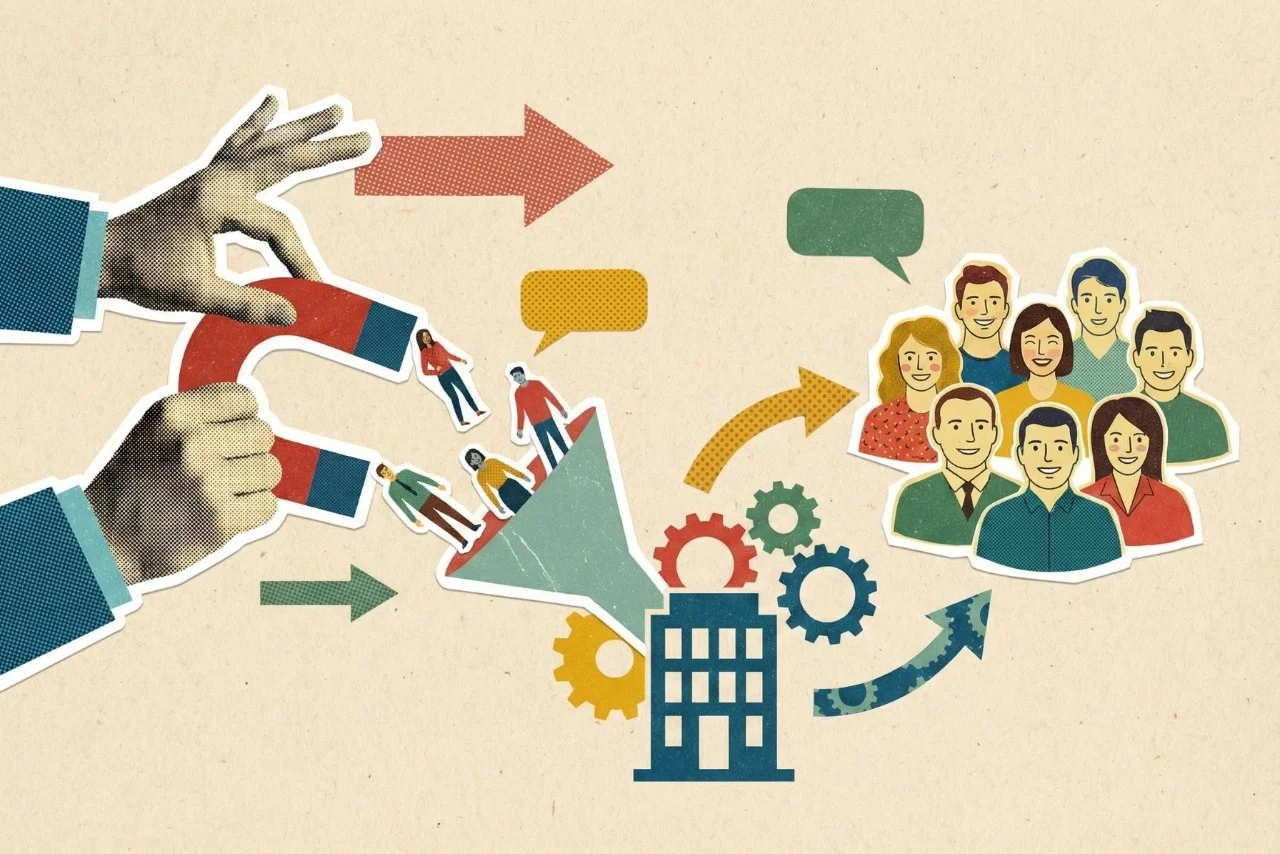
Acquisition doesn’t happen in a vacuum. It follows a journey—often referred to as a “funnel”—where a person moves from general awareness to a final decision. In 2026, this journey is rarely a straight line; it’s a series of touchpoints across search engines, social media, and word-of-mouth.
- Awareness: A potential customer realizes they have a problem or a need and discovers your brand as a possible solution.
- Consideration: They research your product, compare you to competitors, and look for social proof (reviews or case studies).
- Conversion: The “moment of truth” where they sign up or pull out their credit card. This is where a lead officially becomes an acquired customer.
2 Metrics That Define Success
If you are looking at customer acquisition from a growth perspective, you really only need to care about two numbers: CAC and LTV.
Customer Acquisition Cost (CAC)
This is the total cost of your sales and marketing efforts divided by the number of new customers you gained. If you spent $1,000 on ads and got 10 customers, your CAC is $100.
Lifetime Value (LTV)
This is the total profit a customer will bring to your business over the entire time they stay with you.
The Growth Rule: For a business to stay healthy, your LTV should be at least three times higher than your CAC (
LTV:CAC = 3:1). If you spend $100 to get a customer, they need to bring back at least $300 in profit.
Common Acquisition Channels
Depending on where your audience hangs out, you might use different “channels” to find them:
- Organic Search (SEO): Creating content that answers questions so people find you naturally on Google or AI search engines.
- Paid Advertising (PPC): Buying ads on platforms like Meta, Google, or LinkedIn to get immediate traffic.
- Referral Programs: Encouraging your current customers to bring in their friends. This is often the most cost-effective way to grow.
- Content Marketing: Writing guides, whitepapers, or making videos that establish you as an authority in your field.
Why Does Customer Acquisition Matters
In today’s market, customer acquisition is getting more expensive. Privacy laws have made it harder to track users, and the “noise” online is louder than ever. To win today, you can’t just throw money at ads; you have to build a system that is efficient, measurable, and—most importantly—focused on the human on the other side of the screen.
Why LTV and CAC Rule Everything
If you don’t know your numbers, you don’t have a strategy; you have a gamble. In my experience at growth agencies, the companies that scale are those that treat their unit economics as their north star.
The 3:1 Rule
Your Lifetime Value (LTV) – the total profit a customer brings in over their entire relationship with you – must be significantly higher than what you spent to get them.
- The Goal: An LTV to CAC ratio of 3:1 or higher.
- The Danger Zone: If your ratio is 1:1, you aren’t growing; you’re just trading dollars and eventually losing money once you account for rent, salaries, and software.
The Payback Period
This is the “stress test” for your business. It’s the amount of time it takes for a customer to pay back the cost of their own acquisition. If your CAC is $100 and a customer pays you $20 a month, your payback period is 5 months. In a high-interest-rate world, you want this number to be under 12 months. If it takes 24 months to break even on a customer, you will run out of cash before you ever reach scale.
Mapping the Modern Acquisition Funnel
The old funnel was a straight line. The modern funnel is a loop. People move back and forth between searching, comparing, and ignoring your brand before they ever click “buy.”
Awareness in the Age of AI
People aren’t just “Googling” anymore. They are asking AI assistants for the best products. This is called Generative Engine Optimization (GEO). To be found, your brand needs to be mentioned by high-authority sources and expert blogs that these AI models train on. This is where your authority content pays off.
The Consideration Gap
Between seeing your brand and buying your product, there is a “gap.” Most businesses lose people here. To close it, you need high-level social proof. This isn’t just a quote from a happy customer; it’s a deep-dive case study or a data-backed whitepaper that proves you know what you’re doing.
Choosing Your Channels Wisely
Don’t try to be everywhere. It’s better to dominate one or two channels than to be mediocre on five.
- Paid Search & Social: Great for quick results, but expensive. Use this to test messaging and find out what people actually care about.
- Organic Content (SEO): This is your long-term wealth builder. It takes months to kick in, but once it does, your marginal cost per customer drops to nearly zero.
- Referral Loops: This is the “holy grail” of customer acquisition. If your product is so good that one user brings in another, your growth becomes exponential.
Conversion Rate Optimization: The Silent Growth Lever
Most people think the way to get more customers is to buy more traffic. They’re usually wrong.
If your website has a 1% conversion rate and you spend $10,000 on ads, you get 100 customers. If you optimize your site to have a 2% conversion rate, you get 200 customers for the exact same $10,000. Conversion Rate Optimization (CRO) is the only way to effectively cut your CAC in half overnight.
Checklist for a high-converting site:
- Speed: Does the page load in under 2 seconds?
- Clarity: Is the “Buy” button obvious?
- Friction: Can someone check out in 3 clicks or less?
Customer Acquisition Strategy
It costs five times more to acquire a new customer than to keep an old one. If you have a high “churn rate” (people leaving), your customer acquisition efforts are being poured into a leaky bucket.
When you keep a customer longer, their LTV goes up. When LTV goes up, you can afford to spend more on ads than your competitors. In marketing, the company that can afford to spend the most to acquire a customer is usually the one that wins.
Conclusion
Success in customer acquisition today isn’t about “hacking” an algorithm. It’s about being the most relevant, most trusted, and most efficient option in your market. Focus on your data, respect your unit economics, and always prioritize the human on the other side of the screen.
Ready to grow and push for more data backed results? Sign up for GROWTH SIGNAL NEWSLETTER where we publish data backed insights into Growth for Founders like you.
Frequently Asked Questions
How do I calculate CAC accurately?
Take your total marketing and sales spend for a specific period (including salaries and software) and divide it by the number of new customers you gained in that same period.
CAC = Total Marketing + Sales Spend over Number of New Customers
What is a “good” conversion rate?
It varies by industry, but for most e-commerce sites, 2% to 3% is standard. For B2B lead generation, you should aim for 5% to 10% on your landing pages.
Is SEO still worth it with AI search rising?
Yes, but the strategy has changed. You shouldn’t just write for keywords; you should write to be an “authority entity.” AI engines recommend experts, not just pages with high keyword density.