If your AI marketing strategy is still a collection of experiments rather than a system that drives growth – you are not alone, but you are running out of time.
According to Gartner, 65% of CMOs say advances in AI will dramatically change their role within the next two years. That is not a distant forecast. That is now. And yet, most marketing leaders are still stuck in the middle – aware that something important is happening, unsure exactly how to build around it.
The problem is not a lack of enthusiasm. Most companies have people experimenting with AI somewhere. The real issue is that most CMOs are sponsoring AI experiments in small batches across their organisations but are struggling to move from employee experimentation to marketing transformation. There is a big difference between running pilots and running a strategy.
This research is not about AI tools. It is about building a full AI marketing strategy for CMOs that connects to revenue, not just efficiency. By the time you finish reading, you will have a clear roadmap, a budget model, a measurement framework, and answers to the questions your team is probably already asking you.
Let’s do some deep data backed reading.
Why Most CMOs Are Stuck – And What’s Actually Holding Them Back
The starting point for any honest conversation about AI marketing strategy for CMOs is acknowledging what is not working. Too many marketing leaders are running disconnected AI initiatives with no unified direction, no shared data infrastructure, and no way to connect the results back to business outcomes.
Part of the problem is a language gap between CMOs and the rest of the C-suite. CMOs tend to frame AI’s value in terms of marketing effectiveness (57%) and personalisation (45%), while CEOs, CFOs, and CTOs are focused on enterprise value and business growth as AI’s primary contribution. [3] Until marketing leaders start speaking the same language as the people who control the budget, the gap between what is possible and what gets funded will stay wide.
Then there is the training problem. 68% of marketing professionals now use AI daily, but only 17% have received comprehensive, job-specific AI training. [4] You cannot build an AI-powered marketing operation on an undertrained workforce. What you get instead is inconsistent use, unreliable outputs, and frustrated teams who default back to doing things the old way.
The performance data confirms it. Only 5% of marketing leaders who are not piloting AI agents report significant gains in business outcomes, according to a Gartner survey of 413 marketing technology leaders. That is a serious gap between adoption and results.
Speed is also a factor. 63% of CMOs say they are missing growth opportunities because they cannot make decisions fast enough. In most cases, that is not a technology problem – it is a data infrastructure and process problem that AI could actually solve, if it were set up correctly.
The good news is that none of these problems are permanent. They are fixable. But fixing them requires moving from a scattered approach to a real AI marketing strategy – one that is built around your business goals, your data, and your team.
What a Real AI Marketing Strategy Looks Like at the CMO Level
Before you can build one, it helps to understand what separates an AI marketing strategy from a list of AI tools your team happens to be using.
An AI marketing strategy is a deliberate plan that connects AI capabilities to your business goals. It defines where AI will be used, how it will be governed, what data it will run on, how your team will be trained, and how you will measure whether it is working. A tool list is a tactic. A strategy is a system.
The CMOs who are getting this right are not adding complexity. Visionary marketing leaders are responding with radical simplification – creating integrated platforms where data flows seamlessly, AI enhances human capability, and customer experiences remain flawless even as expectations grow. That is a very different approach from chasing every new AI product on the market.
The most practical framework for building an AI marketing strategy for CMOs is a three-horizon roadmap. The solution spans short-, mid-, and long-term horizons – guiding how to use customer data, empower employees, and govern AI-driven work so the organisation stays agile and competitive.
Here is how those three horizons break down in practice:
Short-term (0 to 6 months): Automate repetitive tasks, build prompt libraries, generate and repurpose content faster, and run real-time A/B testing on campaigns already in flight.
Mid-term (6 to 18 months): Build predictive models, personalise customer journeys at scale, integrate AI into your CRM and analytics stack, and use AI-assisted segmentation to improve targeting.
Long-term (18 months and beyond): Explore agentic AI, autonomous campaign management, AI-informed brand strategy, and deeper integration across sales, product, and service teams.
One more important point here: the best CMOs working on AI projects start with their marketing priorities, challenges, and opportunities – not with the technology itself. [2] That order matters. Technology should solve a business problem, not the other way around.
Your organisation’s AI maturity will also shape how fast you can move. Most companies progress from using AI as a tool (automating tasks) to using it as an agent (making decisions) to AI as an influencer of strategy. [7] Knowing where you are on that curve tells you what the realistic next step is.
The 5 Places Where AI Delivers the Biggest Marketing Returns
When you are building your AI marketing strategy, it helps to know where the evidence for ROI is strongest. These five areas have the clearest data behind them.
- Content Production
A typical 1,500-word blog post previously required 8 to 10 hours of work. With AI assistance, the same content now takes under two hours from concept to publication. That is not a marginal improvement – it is a fundamental change in how content teams operate. 90% of content marketers are planning to adopt AI by the end of 2025, which means this is quickly becoming the baseline rather than the exception.
The key here is that AI handles research, first drafts, and optimisation while humans maintain quality control, strategic direction, and brand voice. The combination is what makes it work.
- Hyper-Personalisation
71% of consumers expect personalised interactions from the brands they engage with, and about 80% of customers show a greater likelihood to purchase when those expectations are met. [8] That is a direct revenue connection, not just a customer experience metric.
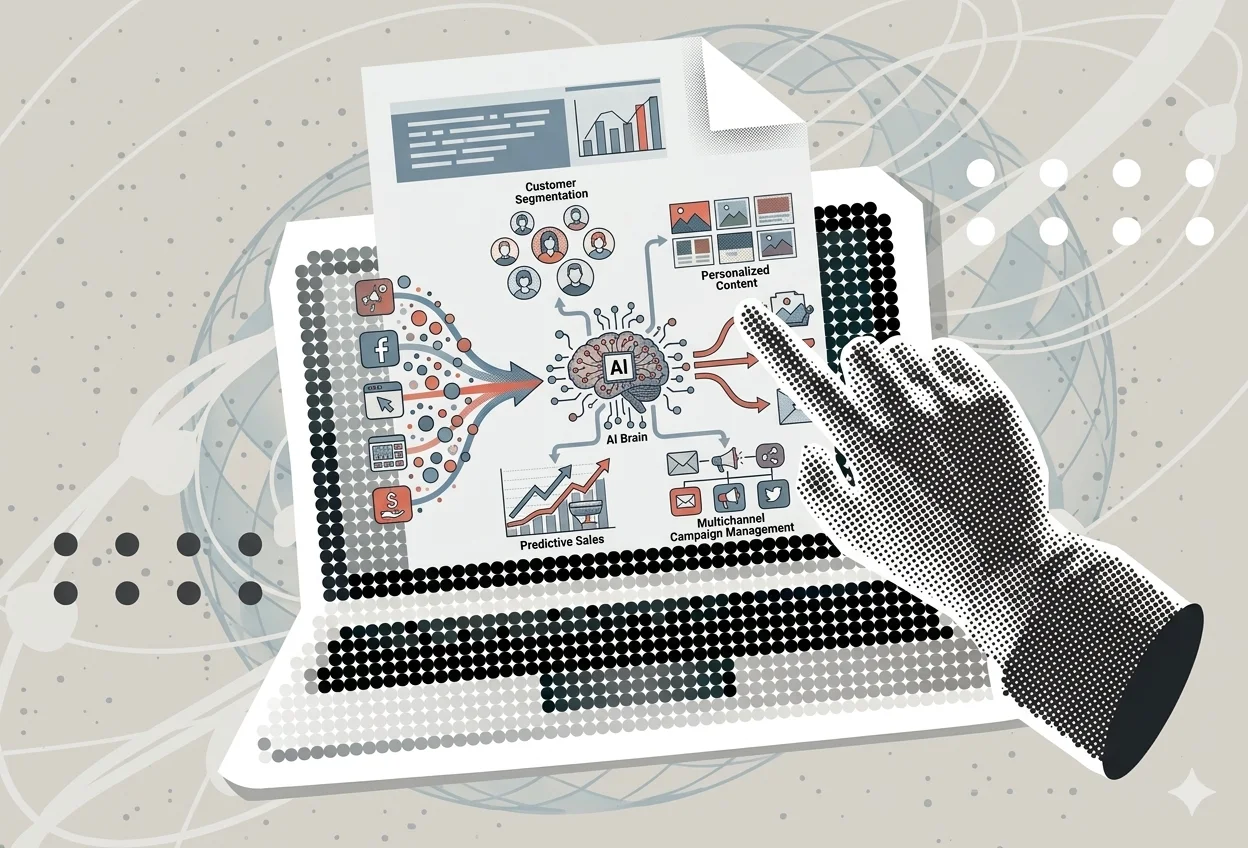
92% of businesses now use AI for campaign personalisation – covering personalised pricing, dynamic visuals, and tailored product suggestions based on browsing behaviour. If your competitors are personalising at this level and you are not, that gap is showing up in your conversion rates.
- Predictive Analytics and Decision Speed
Organisations that use advanced attribution and forecasting methods achieve 25 to 30% higher marketing ROI than those relying on manual or intuition-based planning. That alone is a compelling reason to prioritise predictive analytics as part of your AI marketing strategy.
74% of marketers using AI for audience segmentation report improvements in conversion rates. [9] AI does not just tell you what happened – it tells you what is likely to happen next. That shift from reactive reporting to proactive action is one of the most valuable changes AI enables.
- Paid Media Efficiency
AI-powered PPC bid management reduces ad spend wastage by 37% while increasing ad ROI by 50%. Platforms like Google Performance Max and Meta Advantage+ are already delivering measurable improvements in return on ad spend – not by increasing budgets, but by using data more intelligently.
For CMOs managing flat marketing budgets, this is a practical way to get more from the spend already in place.
- Customer Retention and Loyalty
Here is a number that should concern every CMO: 89% of executives believe their customers have become more loyal over the past few years, but only 39% of consumers say they are actually more loyal to the brands they regularly use. That 50-point perception gap is exactly where AI-powered personalisation and real-time customer experience design can make a real difference.
Marketers who use AI for email personalisation report revenue increases of 41% and click-through rate improvements of 13.44%. Retention is almost always cheaper than acquisition. AI gives you a better shot at earning it.
6 Steps Roadmap for CMOs Ready to Move From Pilot to Strategy
This is the section most guides skip. Here is how to actually build an AI marketing strategy for CMOs in a sequence that works.
Step 1 – Audit where you actually are
Start with an honest inventory. Map every manual, repetitive marketing task currently done by humans. Look at your content process, your reporting, your campaign setup, your email workflows, your ad management. Every step that is still fully manual is a candidate for AI-assisted improvement.
At the same time, assess your data infrastructure. Is your customer data clean, connected, and accessible in real time? CMOs named unclear data ownership and limited access to tools as the top barrier to delivering their AI marketing strategy. If your data is siloed, dirty, or incomplete, AI will not fix that – it will amplify it.
Step 2 – Pick use cases tied to revenue, not convenience
One of the most common mistakes in building a CMO AI strategy is choosing use cases based on what is easiest to implement, not what will move the business forward. Pick two or three use cases that connect directly to pipeline, customer acquisition cost, or retention – and build around those first.
CMOs should focus on redesigning end-to-end workflows where AI disruption is likely to be greatest and most rapid, because those are the initiatives that scale fastest. Quick wins are useful for building internal confidence, but they should not come at the expense of strategic focus.
Step 3 – Fix your data foundation first
This step gets skipped more than any other, and it is the one most likely to sink your AI marketing strategy. CMOs need to partner with their CIO to ensure they have the data infrastructure needed to make the most of generative AI. That means clean customer data, connected systems, and a clear ownership model for who manages it.
Bad data equals bad AI output. There is no shortcut around this.
Step 4 – Train your team before you buy more tools
More tools will not solve an adoption problem. CMOs should invest in a marketing-specific prompt training course for all team members so they move forward collectively with confidence, curiosity, and a shared prompt library specific to their business.
The training investment pays off in measurable ways. Companies that invest in AI education achieve 43% higher project success rates. Without it, you end up with a tool nobody uses consistently and results nobody trusts.
Step 5 – Build governance that protects the brand
AI moves fast. Without guardrails, it can also create problems fast. Establish clear usage guidelines covering brand voice, data privacy, content accuracy, and regulatory compliance before you scale. Responsible AI practices create strategic advantages that improve brand trust, data quality, and the long-term scalability of AI initiatives.
This is not bureaucracy. It is brand protection.
Step 6 – Report results in business language
The final step is how you communicate success. Stop measuring AI in marketing-specific vanity metrics. Start reporting in pipeline, revenue contribution, customer acquisition cost, and CAC payback period. CMOs need to translate marketing outcomes into business outcomes – because CFOs respond to pipeline, revenue, and payback period, not impressions or engagement rates.
When you speak the language of the boardroom, you get the budget to keep going.
How Much Should CMOs Actually Budget for AI Marketing?
The budget question comes up in almost every conversation about AI marketing strategy for CMOs. Here is an honest answer based on current benchmarks.
Marketing budgets have flatlined at 7.7% of company revenue in 2025, with 59% of CMOs reporting insufficient budget to execute their strategy. That means AI investment almost certainly needs to come from reallocation, not expansion.
For CMOs building an AI investment case, the practical starting point is an 8 to 12% allocation of total marketing budget to AI-specific applications in year one, scaling to 15 to 20% in year two if ROI thresholds are met. That is not a small number – but the returns justify it.
GenAI investments are already delivering measurable ROI through improved time efficiency (49%), improved cost efficiency (40%), and improved capacity to produce more content and handle more business (27%). Those are not hypothetical returns. They are what CMOs are already reporting.
Two areas worth reviewing for reallocation:
First, agencies. 39% of CMOs plan to reduce agency budgets in 2025, and 22% say generative AI has already reduced their reliance on external agencies for creativity and strategy. Routine production work – ad copy, content drafting, basic reporting – is increasingly something well-trained internal teams with AI tools can handle.
Second, martech. Martech now accounts for roughly 22% of total marketing budgets, yet a significant portion of those platforms remain underutilised or redundant. Before buying new AI tools, audit what you already have. Consolidate where you can.
In terms of overall budget structure, the highest-performing CMOs treat their marketing budget as a portfolio – with 60 to 70% in proven, revenue-generating channels and 30 to 40% in adaptive and experimental investments, shifting allocations quarterly based on performance data.
| Budget Layer | Recommended Allocation | What It Covers |
| Proven channels | 60–70% | SEO, paid media, email, CRM |
| AI tools and infrastructure | 8–12% (Year 1) | Martech with AI, analytics platforms, GenAI tools |
| Experimental and adaptive | 20–30% | Pilots, agentic AI tests, new channel exploration |
| Training and enablement | 5–8% | Prompt training, AI certifications, team upskilling |
Getting Your Marketing Team to Actually Embrace AI
Technology is the easy part of any AI marketing strategy. Culture is where most implementations hit a wall.
The challenge with AI adoption is often less about the technology and more about overcoming scepticism, shifting rigid ways of working, and building confidence in AI outputs. [5] People need to understand what AI is doing, why it helps them specifically, and what it does not change about their role.
The training gap makes this harder. 68% of marketing professionals use AI daily, but only 17% have received proper, job-specific AI training. Without structured training, you get inconsistent use across the team, variable quality in outputs, and a general lack of trust in AI-generated work. That is not a technology problem. It is a management one.
One of the most effective changes a CMO can make is to reframe how AI is introduced to the team. The question should shift from “How many people can we let go?” to “What can we do with three times more creative capacity?” That change in framing reduces fear and increases engagement significantly.
Define the hybrid model clearly for your team: humans own strategy, brand voice, creative direction, relationship-building, and ethical judgement. AI owns speed, scale, data processing, first-draft creation, and performance analysis. Neither replaces the other – they cover different ground.
The CMOs who succeed embed AI into daily decisions, redesign roles and workflows, and unlock marketing that is more adaptive, accountable, and aligned to the business. That is the outcome to aim for – not just having AI tools, but having a team that knows how to use them well.
The Brand Risk Every CMO Needs to Know About Before Going All-In on AI
Building an AI-powered marketing strategy means understanding not just the opportunities, but the risks. There is one in particular that does not get nearly enough attention: the efficiency trap.
Many CMOs remain focused on short-term efficiency gains – and in doing so, risk eroding brand differentiation. [7] When every marketing team in your industry uses the same AI tools to produce content at the same speed, the output starts to look the same. Brand sameness is one of the most dangerous competitive positions a company can be in.
There is also a structural shift happening in search that every CMO needs to factor into their AI marketing strategy. A recent study of 300,000 keywords found that the presence of an AI Overview in search results correlated with a 34.5% lower average click-through rate for the top-ranking page. [6] If you are still relying on organic traffic as a primary channel, that number should change how you think about content strategy.
The dual customer journey concept is also worth understanding here. Marketers must now plan for two parallel journeys – those of AI tools and agents researching and evaluating options, and those of humans acting on the outputs. Human touchpoints are becoming more scarce, which means each one needs to count more than before.
Responsible AI use is not a compliance issue. It is a competitive advantage. Customers notice when brands use their data carelessly, produce generic content, or automate in ways that feel impersonal. Trust, once lost, is expensive to rebuild.
Two terms worth adding to your strategy vocabulary: Generative Engine Optimisation (GEO) and Answer Engine Optimisation (AEO). These are the emerging disciplines for getting your brand cited in AI-generated search responses – and they are quickly becoming as important as traditional SEO in a well-rounded AI marketing strategy for CMOs.
What the Top-Performing CMOs Are Doing Differently Right Now
It would be easy to describe a list of tactics here. But what actually separates the CMOs getting results from those still stuck in experimentation is not tactics – it is mindset and structure.
Leading marketers are using AI to elevate marketing’s role in growth – turning efficiency into effectiveness, data into decisions, and creativity into measurable enterprise value. That is a fundamentally different orientation from using AI to cut costs or reduce headcount.
The CMOs who are defining the next decade of marketing are building platforms, not accumulating tools. They are architecting outcomes rather than chasing campaigns. They hire for human qualities – judgement, creativity, empathy – and train for AI skills. That combination is hard to replicate and hard to compete against.
They have also figured out how to talk to the C-suite. Until marketing leaders align on language and outcomes with the rest of the executive team, organisations struggle to scale AI across marketing. The CMOs gaining ground are the ones who walk into board meetings with pipeline numbers, CAC data, and revenue attribution – not engagement reports.
The mandate for change is already there. 92% of CMOs say they have C-suite support to make bold bets on AI. The gap is not permission. The gap is a clear, well-structured AI marketing strategy for CMOs that turns that support into results.
The Metrics That Tell You If Your AI Marketing Strategy Is Actually Working
One of the clearest signs that an AI marketing strategy for CMOs is working is when marketing stops reporting in marketing-speak and starts reporting in business outcomes.
Here is what the data says about what is actually measurable. Organisations implementing AI report average revenue increases of 41% and reductions in customer acquisition cost of 32%. Marketing teams using AI achieve 44% higher productivity, saving an average of 11 hours per week.
AI usage in marketing now powers 17.2% of total marketing efforts and correlates with 8.6% higher sales productivity, 8.5% better customer satisfaction, and 10.8% lower overhead costs. Those are the numbers that translate directly to CFO language.
Here is the measurement framework that connects AI marketing to business outcomes:
| Metric Category | What to Track | Why It Matters to the C-Suite |
| Revenue | Pipeline per marketing dollar | Connects AI investment to revenue directly |
| Efficiency | Hours saved per campaign | Shows productivity gains in real terms |
| Cost | Customer Acquisition Cost (CAC) | Direct business impact metric |
| Engagement | Personalisation-driven conversion rate | Proves personalisation ROI |
| Retention | Customer Lifetime Value (CLV) | Shows long-term value of AI-driven loyalty |
| Adoption | % of team using AI tools weekly | Tracks internal transformation progress |
The bottom line: your AI marketing strategy for CMOs is only as strong as how clearly and consistently you can prove it is working. Build the measurement framework before you launch the strategy, not after.
Where the CMO Role Is Heading – and Why AI Is at the Centre of It
The question is not whether AI will change the CMO role. It already is. The question is whether you are shaping that change or reacting to it.
According to Gartner, the CMO role is evolving from influencer to designer of business impact. Success in this environment requires marketing leaders to set clear strategic direction, adapt to AI-driven customer journeys, and create authentic, differentiated value. That is a broader remit than most CMO job descriptions currently reflect – and a more valuable one.
The trajectory is clear. By 2027, approximately 88% of marketers will use AI daily in their work. Budget allocations for AI initiatives are expected to reach 40 to 50% of total marketing spend by 2028.] Teams that invest strategically in AI now could see three to five times returns by 2030 as AI systems learn and improve with each campaign cycle.
The destination most forward-thinking organisations are moving toward is not AI-first or human-first – it is what some researchers call hybrid intelligence. Humans own strategy, brand voice, creative judgement, and relationship-building. AI accelerates analysis, content creation, personalisation, campaign execution, and performance reporting. The two work together in a deliberate design, not in competition.
The CMOs who build a real AI marketing strategy today are not just keeping pace with the market. They are setting the pace for everyone else.
Conclusion
Here is the summary: AI marketing strategy for CMOs is not a technology project. It is a business transformation project. The technology is available, the data is revealing, and the mandate from the C-suite is already there for most of us.
The missing point for too many marketing leaders is the structure to turn all of that into a system that consistently drives revenue, retains customers, and proves its value in terms the whole business can understand.
That structure starts with an honest audit of where you are, a clear decision about where AI can move your most important business metrics, and the discipline to train your team, fix your data, and measure what actually matters.
The companies that will dominate marketing over the next five years are already building this. Some of your competitors are in that group. The gap between where you are now and where you need to be is not as wide as it might feel – but it does require a decision to move from experimenting to building.
Start with the roadmap. Build the system. Prove it works. That is the job.
If this research gave you something useful to work with, there is more where this came from.
Every week, we send one newsletter to growth-focused marketing leaders – no recycled insight, no trending lists, no filler. Just clear thinking on what is actually working in AI-powered growth marketing, backed by data and fact-checked application.
We cover things like how to structure marketing teams around AI, how to present AI ROI to your CFO, where the most undervalued channels are right now, and how the best CMOs are rebuilding their operating models for 2025 and beyond. You can also check some of our verticals on: Trends, AI Marketing, Growth Marketing, Strategies.
If that sounds like the kind of thinking you want in your inbox, join us here:
Subscribe to the The Growth Signal Newsletter →
Frequently Asked Questions
What is an AI marketing strategy for CMOs, and how is it different from just using AI tools?
An AI marketing strategy for CMOs is a deliberate plan that connects AI to your business goals – not a list of tools your team experiments with. The difference is intent and integration. Using an AI writing tool is a tactic. Building a system where AI powers your personalisation engine, speeds up your content pipeline, and informs your budget decisions in real time – that is a strategy. CMOs who focus only on isolated tools or pure efficiency gains miss the bigger picture: the real opportunity is in using AI to reinvent the entire marketing operating model. One is task-level. The other is transformation.
How much of a marketing budget should go toward AI?
There is no single right answer, but there is a data-backed starting point. Most CMOs building an AI investment case begin with an 8 to 12% allocation of total marketing budget to AI-specific applications in year one, scaling to 15 to 20% in year two if ROI thresholds are met. [14] The smarter approach is to fund AI through reallocation, not expansion. 39% of CMOs are already cutting agency budgets, and 22% say generative AI has reduced their reliance on external agencies for creativity and strategy. That freed-up budget is a natural source of AI investment without asking for additional spend.
What AI use cases should CMOs prioritise first?
Start where the ROI is clearest and the implementation is most manageable. The five use cases with the strongest evidence are content production, hyper-personalisation, predictive analytics, paid media optimisation, and customer retention. Content and paid media tend to deliver the fastest early wins. AI reduces content creation time from 8 to 10 hours per piece to under two hours. [8] AI-powered PPC bid management reduces ad spend wastage by 37% while increasing ad ROI by 50%. Prioritise the use cases tied directly to pipeline or customer acquisition cost reduction, not the ones that are simply easiest to implement.
How do CMOs prove AI marketing ROI to the CFO?
Speak in numbers the CFO already cares about. That means pipeline, revenue influenced, customer acquisition cost, and CAC payback period – not engagement rates or content volume. Organisations implementing AI report average revenue increases of 41% and reductions in customer acquisition cost of 32%. Build three scenarios – conservative, likely, and optimistic – and show what happens at different adoption levels. Document your baseline before any AI investment, then report against it quarterly. When CFOs see you have modelled the downside scenarios, they trust your upside projections far more.
How do you get a marketing team to actually adopt AI consistently?
Culture is almost always the real obstacle. Most resistance comes from people worried about being replaced. The most effective reframe is to shift from “How many people can we let go?” to “What can we do with three times more creative capacity?” Then invest in real training. Companies that invest in AI education achieve 43% higher project success rates, yet only 17% of marketing professionals have received proper, job-specific AI training. Build a shared prompt library, run regular AI skill sessions, and make adoption visible through team-level KPIs – not just individual output.
What is the biggest risk of building an AI marketing strategy without the right data?
Your AI is only as useful as the data it runs on. Without clean, connected, real-time data, AI tools produce irrelevant outputs, unreliable predictions, and wasted spend. CMOs named unclear data ownership and limited access to tools as the top barrier to delivering an effective AI marketing strategy. That problem shows up directly in growth metrics. 63% of CMOs say they are already missing opportunities because they cannot make decisions fast enough – and slow decisions almost always trace back to a data infrastructure problem. Fix the plumbing before you build the engine.
How is AI changing the CMO role going forward?
Significantly and permanently. The CMO role is evolving from influencer to designer of business impact – requiring clear strategic direction, an ability to adapt to AI-driven customer journeys, and a focus on authentic, differentiated brand value. CMOs who embrace AI are not doing less – they are taking on more. They are moving from managing campaigns to building growth systems that span sales, product, service, and marketing. By 2027, approximately 88% of marketers will use AI daily, and AI budget allocations are expected to reach 40 to 50% of total marketing spend by 2028. The CMOs who prepare for that world now will have a significant head start.
What does a hybrid AI marketing team actually look like?
A hybrid AI marketing team is not about replacing people with automation. It is a deliberate structure where humans and AI each focus on what they do best. Humans handle strategy, brand voice, creative direction, relationship-building, and ethical judgement. AI handles research, data analysis, first-draft content creation, audience segmentation, campaign optimisation, and performance reporting. In practice, a strategist spends less time pulling reports and more time acting on insights. A content writer spends less time on first drafts and more time on quality, nuance, and tone. The CMOs who succeed redesign roles and workflows so people and AI work together – not in parallel, and not in competition.
References
- Gartner. (2025). Gartner Survey Finds 65% of CMOs Say Advances in AI Will Dramatically Change Their Role in the Next Two Years
- MarketingProfs. (2025). AI in Marketing: Three Strategic Steps CMOs Should Take Now.
- Boston Consulting Group. (2025). From Campaigns to Business Value: How AI Will Transform Marketing.
- LoopEx Digital. (2026). AI Marketing Statistics 2026: The Complete Performance
- PwC. (2025). 2026 Growth Strategy for Chief Marketing Officers.
- IBM Institute for Business Value. (2025). The CMO Revolution: 5 Growth Moves to Win with AI.
- Gartner. (2025). How CMOs Can Build an AI-Ready Marketing Strategy
- Cubeo AI. (2025). 25 AI Marketing Statistics Every CMO Should Know in 2025
- Litslink. (2025). AI Marketing Statistics in 2025: Key Insights for Brands
- Evokad. (2025). Marketing Budget Optimization with Limited Resources in 2025
- Revenue Memo. (2026). Small Business Marketing Budget Statistics for 2026
- Typeface AI. (2026). The CMO’s Guide to AI Marketing ROI (That Actually Gets Budget Approval)
- Gartner. (2025). Gartner 2025 CMO Spend Survey Reveals Marketing Budgets Have Flatlined at 7.7% of Overall Company Revenue
- Real Internet Sales. (2025). The CMO’s Guide to AI Marketing Budget Allocation in 2025
- Averi AI. (2025). The 2026 Marketing Budget Reality Check
- Single Grain. (2025). 2025 Marketing Budget: Insights from 11,000+ CMOs.