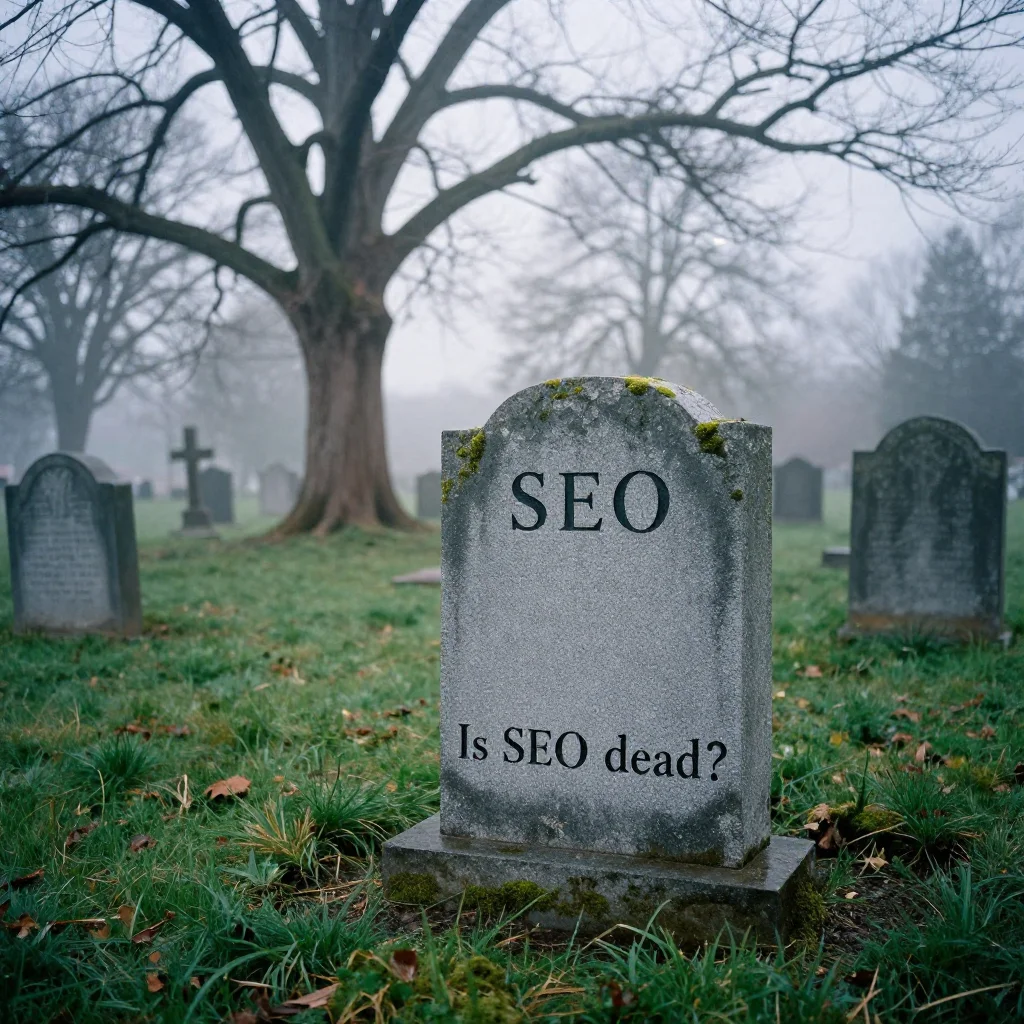
Every time Google updates its algorithm or a new AI tool launches, the industry panics. We’ve seen this cycle at play over and over. The noise is louder than ever because of the rise of Answer Engines Optimization. People look at the shrinking space for organic links and naturally wonder, Is SEO dead?
The short answer is no. However, the SEO that relied on keyword frequency and lots of backlinking strategy is definitely on the ground. What we are seeing now is not the death of search, but the death of low – quality results. Search engines have evolved into sophisticated systems that prioritize intent and authority over simple text matching.
We’ve seen lots of businesses stop looking at SEO as a standalone channel. It is now often viewed as an integrated part of a brand’s authority ecosystem. If you are still trying to “game” the system with thin content, then for your business, is SEO dead? Yes. But if you are building a repository of genuine expertise, the opportunity has never been larger.
The Data Behind the Drama: Are Clicks Disappearing?
The primary reason people keep asking, Is SEO dead, is the rise of the “Zero – Click” search. Data from the last twelve months shows that over 60% of mobile queries are resolved directly on the search results page. Google’s AI Overviews and the Search Generative Experience (SGE) provide the answer before a user ever has to click a link.

From a growth perspective, this looks like a disaster on paper. Your organic traffic might be dipping, but your “Search Share of Voice” could be at an all – time high. We have to change how we measure success. If a user sees your brand cited as the primary source in an AI – generated answer, that is a high – value touchpoint. It builds trust before they even land on your site.
When people ask us, is SEO dead because of these AI Overviews, we show them the conversion data. While total “informational” traffic might be down, the traffic that does reach the site is often further down the funnel. They’ve already had their basic questions answered and are now looking for the specific expertise or service you provide.
Generative Engine Optimization (GEO) vs. Traditional SEO
We’ve transitioned from traditional search to what we call Generative Engine Optimization (GEO). The old goal was to rank #1. The new goal is to be the “Cited Source.” When an AI like Gemini or Perplexity synthesizes an answer, it pulls from a handful of trusted nodes.
If your content isn’t structured to be easily digested by these Large Language Models (LLMs), then you’ll find yourself asking, is SEO dead? It’s not. You just haven’t optimized for the way machines read today. GEO requires a focus on “Information Density.” You need to provide more value per paragraph than your competitors.
We’ve found that content with clear, declarative statements and high “Information Gain” – meaning you are saying something new, not just repeating the top 10 results – is what gets cited. This is how you win in 2026. You don’t just write for a keyword; you write to become an authority that the AI cannot ignore.
The 2025 – 2026 Algorithm Fallout: What Actually Died?
The “Helpful Content” updates of 2025 were a wake – up call. They targeted what we call “AI Content Slop” – mass – produced, unverified articles designed solely to capture search volume. If your strategy was built on that, then is SEO dead? In that case, the answer is a resounding yes.
Google’s June 2025 Core Update specifically penalized sites that lacked “Experience.” They want to see that a human with real – world knowledge is behind the words. We’ve seen legacy sites lose 40% of their traffic overnight because they relied on generic summaries.
At a premium agency level, we don’t use AI to write the content; we use it to analyze the gaps in existing content. We then fill those gaps with proprietary data and human insights. This is why our clients don’t worry about whether is SEO dead. They know that as long as they provide unique value, the algorithm will find a place for them.
E – E – A – T as the Ultimate Growth Moat
Experience, Expertise, Authoritativeness, and Trustworthiness (E – E – A – T) are no longer just “nice to have” guidelines. They are the foundation of searches as outlined by Google in their policy. This is the ultimate answer to the question: is SEO dead? It can’t be dead as long as people need experts they can trust.
Experience is the one thing AI cannot fake. It can’t tell you what happened during a specific client meeting or the results of a unique A/B test you ran in February. In our work, we lean heavily into these personal narratives. We include screenshots of our dashboards, specific case study numbers, and “lessons learned.”
This level of detail creates a “moat” around your content. It makes it impossible for a competitor to simply “rewrite” your article with an AI tool and outrank you. If you aren’t leaning into your unique experience, you’ll always be looking over your shoulder wondering, is SEO dead.
Beyond Google: Fragmented Discovery in 2026
One of the biggest shifts we’ve navigated is the fragmentation of search. For many demographics, the answer to is SEO dead depends on where they are looking. Gen Z often starts their search on TikTok or Reddit.
This doesn’t mean you stop doing SEO; it means your SEO strategy must include these platforms. Reddit, in particular, has become a massive authority signal for Google. We’ve seen that “Search Intent” is often best satisfied by a community discussion rather than a polished blog post.
As growth hackers, we optimize for the entire discovery ecosystem. We ensure our clients are the “authority of record” on Reddit threads, YouTube descriptions, and even within AI chat interfaces. SEO has moved from a single – channel tactic to a multi – surface strategy.
Technical SEO in the Age of AI Crawlers
Technical SEO has changed, but it’s more critical than ever. We aren’t just optimizing for “Googlebot” anymore; we’re optimizing for “AI Agents.” This involves using advanced Schema Markup to tell the AI exactly what your data means.
If your site’s technical foundation is messy, the AI will skip over you. In that scenario, is SEO dead? For your site, yes. It becomes “un – indexable” by modern standards. We focus on “Machine – Readable Content.” This means using structured data to define entities, relationships, and facts within your articles.
Speed also remains a non – negotiable. With the 2026 Core Web Vitals 2.0 update, interaction to next paint (INP) and visual stability are even more heavily weighted. A slow site isn’t just a bad user experience; it’s a signal to search engines that your brand isn’t premium or reliable.
The ROI of Visibility: Turning Citations into Revenue
At the end of the day, we care about revenue, not just rankings. The people who think is SEO dead are usually the ones who only track vanity metrics like “Total Impressions.”
In 2026, we focus on “Bottom – of – Funnel” (BOFU) keywords. We would rather have 50 people search for “premium growth agency for fintech” than 5,000 people search for “what is growth marketing.” The former has intent; the latter is just browsing.
By focusing on high – intent clusters, we ensure that SEO remains a high – ROI channel. We use search to feed our clients’ ecosystems – driving users to newsletters, webinars, and direct sales calls. If you view SEO as a way to build a long – term relationship with a customer, you will never have to ask, is SEO dead.
Conclusion:
The landscape of search has shifted permanently. The question is SEO dead is a distraction from the real work: building a brand that people and machines trust. If you provide genuine value, stay technically sound, and lean into your unique experience, you will win the search game in 2026 and beyond.
The goal isn’t to chase the algorithm; it’s to be the reason the algorithm exists in the first place. You want to be the best answer for your customer’s problem. When you achieve that, the “death” of any specific tactic doesn’t matter.
Ready to grow and push for more data backed results? Sign up for GROWTH SIGNAL NEWSLETTER where we publish data backed insights into Growth for Founders like you.
Frequently Asked Questions
Is SEO dead for small businesses with small budgets?
Not at all. It just requires more focus. Small businesses should focus on “Local SEO” and niche “Topical Authority.” You don’t need to win the whole world; you just need to win your specific corner of it.
How do I compete with AI Overviews?
Don’t compete with them; feed them. Structure your content so that the AI can easily use you as a source. Use clear headings, bullet points, and original data that the AI will want to cite.
Should I stop focusing on backlinks?
No, but the quality threshold has changed. One link from a high – authority, relevant industry site is worth more than a thousand generic directory links. Think of it as “Digital PR” rather than “Link Building.”
Is SEO dead if I only use AI to write my blogs?
If you use AI to generate generic content without human oversight or original data, you will likely see your rankings vanish. AI is a tool for drafting and research, not a replacement for expertise.