
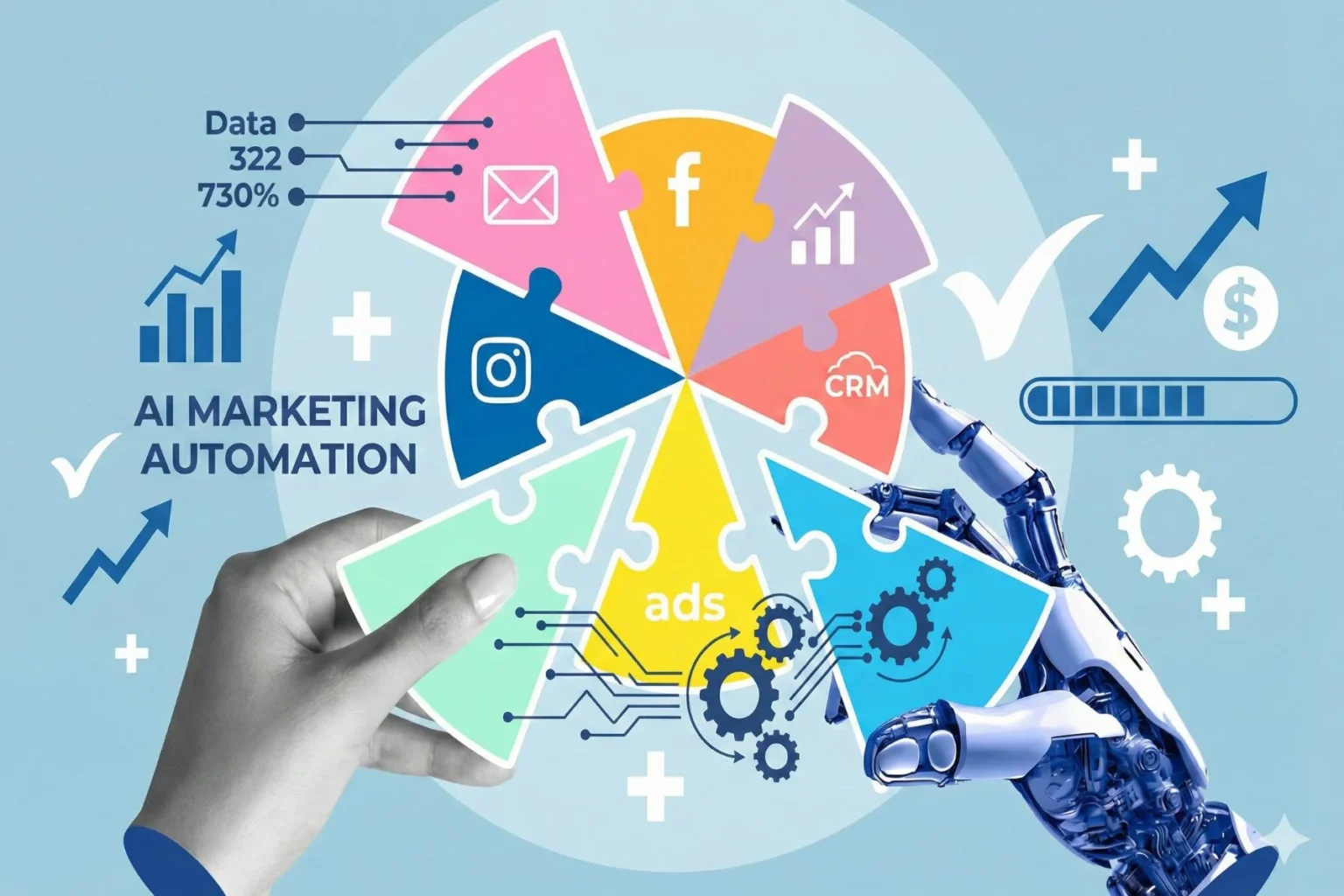
For years, marketing automation was synonymous with rigid workflows and basic “if – then” logic. You built a sequence, set a trigger, and hoped the message stayed relevant. But today, the landscape has shifted. We have moved from static automation into the era of autonomous growth. Today, AI marketing automation is now the central nervous system of a modern business.
We have seen that the brands winning the market are those that stop treating AI as a side project and start using it as an operational tool. Let’s dissect how to build a system that thinks, learns, and scales without constant manual input.
The Shift from Manual Workflows to Autonomous Orchestration
Traditional marketing automation relied on human marketers to guess every possible customer path. If a user clicked a link, you sent email A. If they did not, you sent email B. This worked for a decade, but it is too slow for the current market.
Modern AI marketing automation uses probabilistic modeling. Instead of following a fixed path, the system looks at thousands of data points – from past purchase history to real – time session behavior – to decide the best next move. This is known as autonomous orchestration. It removes the bottleneck of human decision – making in the execution phase, allowing teams to focus entirely on high – level strategy and creative direction.

Key Components of an Autonomous System
- Self – Correcting Loops: The system identifies when a campaign is underperforming and reallocates budget or swaps creative assets in real – time.
- Model Context Protocol (MCP): This is the technical standard that allows your AI agents to access data across different platforms (CRM, Analytics, Ad Managers) securely and instantly.
- Predictive Lead Scoring: Moving away from points – based systems to machine learning models that predict the likelihood of a conversion based on subtle behavioral patterns.
Data Unification and the Model Context Protocol (MCP)
The biggest barrier to effective AI marketing automation has always been siloed data. If your email tool cannot see what happens in your sales calls, the automation is blind.
We solve this using the Model Context Protocol (MCP). Think of MCP as a universal translator for your business data. It allows different AI models to “read” your database without requiring a massive, custom – built integration for every new tool. This enables a level of data unification that was previously impossible for mid – market companies.
When your data is unified, your AI marketing automation engine can perform predictive analytics with extreme accuracy. It can see that a customer who watches 80% of a specific product video and visits the pricing page twice is 5x more likely to convert if offered a specific case study rather than a discount code. This is the difference between generic marketing and high – authority growth hacking.
Invisible Personalization and the Role of Zero – Party Data
Personalization used to be about inserting a first name into a subject line. Implement “Invisible Personalization.” This is where the user experience adapts so naturally to the individual that they do not even realize a machine is orchestrating it.
To do this effectively while respecting modern privacy standards, AI marketing automation now relies heavily on zero – party data. This is information that customers intentionally and proactively share with you.
How to use Zero – Party Data in Automation:
- Interactive Quizzes: Using AI to generate personalized result paths that feed directly into your CRM.
- Preference Centers: Allowing users to dictate the frequency and tone of their interactions.
- Sentiment Analysis: Using AI to analyze the language in support tickets or chat logs to adjust the marketing tone for that specific user.
By combining zero – party data with AI marketing automation, you create a feedback loop that respects privacy while delivering higher conversion rates than traditional tracking ever could.
Generative Engine Optimization (GEO) and Content Strategy
The way people find information has changed. With the rise of AI search agents like Perplexity and SearchGPT, traditional SEO is only one part of the puzzle. You now need to optimize for Generative Engine Optimization (GEO).
Your AI marketing automation stack should include tools that ensure your brand is machine – readable. This means using structured data and semantic HTML so that when an AI agent researches a topic, it cites your brand as the authority.
Content is no longer about volume; it is about “Expertise, Experience, Authoritativeness, and Trustworthiness” (E – E – A – T). We use AI to identify content gaps and research topics, but the final output must be human focused. The goal of AI marketing automation in content is to compress the production cycle – taking a post from an idea to a multi – channel campaign in hours instead of weeks – without sacrificing the human touch.
Operational Excellence and Production Cycle Compression
One of the most immediate results of implementing a premium AI marketing automation strategy is the compression of production cycles. At our agency, we have helped clients reduce their creative turnaround time by over 60%.
When you use Agentic Workflows – AI agents that can perform tasks like resizing images, drafting social copy, and setting up tracking links – your human team is no longer bogged down by “grunt work.” This efficiency allows for Dynamic Creative Optimization (DCO). You can run 500 variations of an ad, each tailored to a specific audience segment, all managed by your AI marketing automation engine.
Real – World ROI of Autonomous Operations:
- Resource Allocation: Reallocating 30% of your marketing budget from manual operations to creative experimentation.
- Scale: Launching campaigns across 10+ languages and regions simultaneously with localized, AI – checked content.
- Accuracy: Reducing human error in data entry and lead routing to near zero.
Predictive Analytics and Customer Retention
Growth is not just about acquisition; it is about retention. AI marketing automation is a powerful tool for increasing Customer Lifetime Value (LTV).
By using predictive analytics, the system can identify “churn signals” before the customer even knows they are unhappy. Perhaps their usage frequency has dropped, or they have stopped engaging with your newsletter. An autonomous system can trigger a personalized retention workflow – such as a check – in call or a specific feature walkthrough – to re – engage the user.
The brands that dominate are those that use AI marketing automation to predict the future rather than just reporting on the past.
Conclusion
The future of growth belongs to those who can blend human creativity with machine intelligence. AI marketing automation is no longer a luxury for tech giants; it is a necessity for any brand that wants to remain relevant in 2026. By focusing on data unification, autonomous orchestration, and invisible personalization, you can build a growth engine that scales as fast as your ambition.
Ready to grow and push for more data backed results? Sign up for GROWTH SIGNAL NEWSLETTER where we publish data backed insights into Growth for Founders like you.
Frequently Asked Questions
What is the difference between AI Marketing Automation and regular automation?
Regular automation follows a set of pre – defined rules (If X, then Y). AI marketing automation uses machine learning to make decisions based on patterns and probabilities, allowing it to adapt to new situations without human intervention.
How do I start with AI Marketing Automation?
Start by unifying your data. Use the Model Context Protocol (MCP) to connect your siloed apps. Once your data is in one place, you can begin using AI for predictive lead scoring and content orchestration.
Does AI marketing sound robotic to customers?
Only if it is used poorly. When used correctly, AI marketing automation actually makes your brand feel more human because it allows you to be more relevant and timely. It should handle the data and timing, while humans handle the story and emotion.
What is the cost of implementing these autonomous systems?
While the initial setup requires an investment in technology and strategy, the long – term ROI comes from the massive reduction in manual labor and the increase in conversion rates through hyper – personalization.