This guide is built from the ground up based on observation from various agencies we’ve interacted with. The market is too crowded for mediocre products backed by aggressive sales teams. Buyers have shifted. They want to touch, feel, and find value in a tool before they ever consider a contract. This is the exact framework we use to transition companies from traditional models to a high-velocity PLG strategy for SaaS.
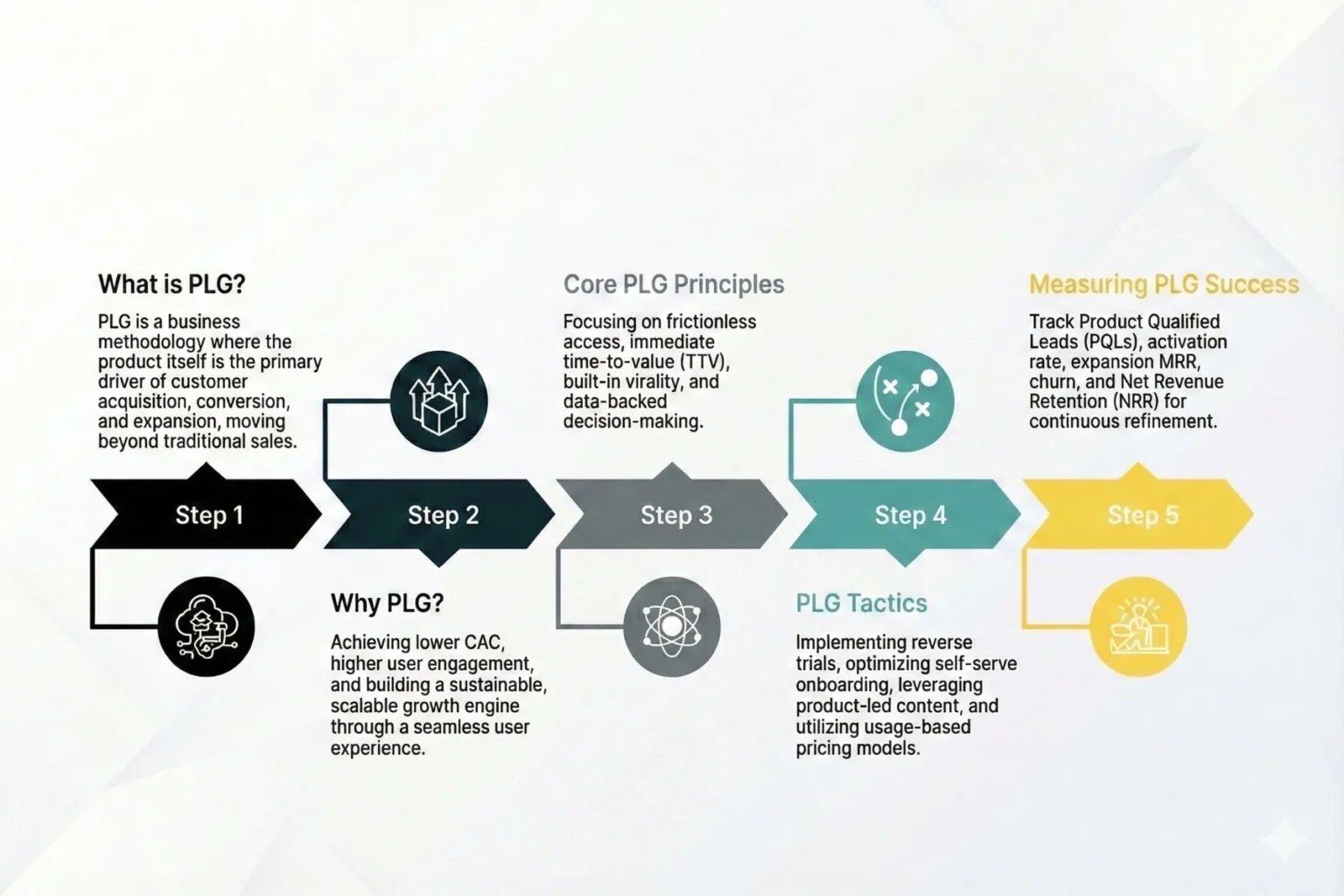
Product-Led Growth (PLG) is no longer a “nice to have” or an experimental side project for startups. It is the dominant architectural framework for modern software. If your PLG strategy for SaaS isn’t the core of your business model, you are likely overpaying for customers who don’t want to talk to your sales team anyway.
Why Your PLG Strategy for SaaS Matters Now
The cost of customer acquisition (CAC) has skyrocketed. Traditional outbound sales and heavy ad spend are seeing diminishing returns. This is where a PLG strategy for SaaS changes the game. Instead of using humans to sell the software, we use the software to sell itself.
Buyers demand immediate gratification. They are “self-serve native.” This shift means that if your product is hidden behind a “Book a Demo” button, you are creating a friction point that your competitors – who likely have a robust PLG strategy for SaaS – will exploit.
Growth hacking in this era isn’t about “tricking” the algorithm. It’s about building a product so intuitive that the user journey from landing page to “Aha! Moment” is seamless. By implementing a PLG strategy for SaaS, you align your success with the user’s success. If they get value, you get revenue. It’s that simple.
The Pillars of a High-Impact PLG Strategy for SaaS
To build a sustainable PLG strategy for SaaS, you need more than just a free trial. You need a foundation built on three specific pillars:
- Frictionless Access: Your sign-up flow should be as fast as a consumer app. If you’re asking for 15 form fields before a user can see the dashboard, your PLG strategy for SaaS is already failing.
- Value Before Revenue: This is the “Give-to-Get” model. You must provide significant utility before you ask for a credit card. Whether it’s through a freemium tier or a full-featured trial, value must come first.
- Built-in Virality: The most efficient PLG strategy for SaaS uses the product as an acquisition channel. Think of how Slack spreads through a team or how Calendly reaches new users every time a meeting is booked. This is engineering growth into the UI.
Solving for Time-to-Value (TTV)
In any PLG strategy for SaaS, the most critical metric is Time-to-Value (TTV). This is the duration between a user signing up and realizing the product actually solves their problem – often called the “Aha! Moment.”
At our agency, we’ve found that if a user doesn’t reach activation within the first five minutes, the likelihood of churn increases by over 60%. To optimize your PLG strategy for SaaS, you must ruthlessly eliminate any steps that don’t lead directly to that first win.
Use product analytics tools like Amplitude or Mixpanel to map exactly where users drop off. If they get stuck in settings, move settings to later. If they struggle with data import, build an automated integration. A winning PLG strategy for SaaS is obsessed with the first 300 seconds of the user experience.
Tracking the Right Metrics for Success
The old world of marketing relied on Marketing Qualified Leads (MQLs) – people who downloaded a whitepaper or clicked an ad. In a PLG strategy for SaaS, MQLs are a vanity metric. What matters now is the Product Qualified Lead (PQL).
A PQL is someone who has used the product and performed “meaningful actions” that indicate readiness to buy. For example, in a communication tool, a PQL might be a user who has sent 50 messages in 48 hours. By focusing your PLG strategy for SaaS on PQLs, your sales team (if you have one) only talks to people who already love the product.
Your “North Star Metric” should reflect this usage. Whether it’s “files shared,” “tasks completed,” or “minutes spent in-app,” this metric is the heartbeat of your PLG strategy for SaaS.
Pricing and Monetization: The “Reverse Trial” and Beyond
Pricing is a feature, not a footnote. In a 2026 PLG strategy for SaaS, we are seeing a massive shift toward the “Reverse Trial.”
In this model, you give every new user the “Pro” version of your product for 14 days. If they don’t pay at the end, they don’t lose access – they are simply downgraded to a limited free version. This keeps them in your ecosystem while showing them exactly what they are missing by not paying.
Another key component of a modern PLG strategy for SaaS is usage-based pricing. Aligning your cost with the value the user receives (like charging per email sent or per gigabyte of data) ensures that your revenue scales naturally as your customers grow.
Scaling with Product-Led Sales (PLS)
A common misconception is that a PLG strategy for SaaS means you don’t need a sales team. That’s false. You need a different kind of sales team. This is Product-Led Sales (PLS).
Instead of cold calling, your sales-assist team looks at the data. They see a small team of 10 people at a Fortune 500 company using your product under a free plan. They reach out not to “sell,” but to help that team navigate enterprise security, single sign-on (SSO), and centralized billing.
This “Land and Expand” approach is the ultimate evolution of a PLG strategy for SaaS. You land through the product and expand through human relationships backed by data.
The Future: AI-Driven Personalization and Growth
As we look toward the rest of 2026, AI is becoming the connective tissue of a PLG strategy for SaaS. We are moving away from static onboarding flows to “Generative Onboarding.”
Imagine a user signs up and, based on their job title and initial behavior, the AI reconfigures the UI to show only the features they need. This level of personalization at scale is how a PLG strategy for SaaS stays competitive. AI can also predict churn before it happens by identifying subtle changes in usage patterns, allowing you to trigger automated “re-engagement” loops.
Implementation: A Step-by-Step Transition Guide
If you are moving from a sales-led model to a PLG strategy for SaaS, don’t try to change everything overnight.
- Phase 1: The Friction Audit. Use tools like Hotjar or FullStory to watch users struggle with your current flow. Fix the bugs and remove unnecessary steps.
- Phase 2: Define PQL Triggers. Identify the 3 – 5 actions that correlate most with long-term retention.
- Phase 3: Ship the Self-Serve MVP. Create a way for users to sign up without talking to anyone. Even if it’s a “lite” version of your tool.
- Phase 4: Iterate. A PLG strategy for SaaS is never finished. Use A/B testing to constantly refine your “Aha! Moment.”
Conclusion
The data is clear: companies that lead with their product grow faster and more efficiently. A PLG strategy for SaaS isn’t just a trend – it’s a reflection of how people want to buy in 2026. By focusing on user value, reducing friction, and leveraging product data, you aren’t just building a software company; you’re building a growth engine.
Ready to grow and push for more data backed results? Sign up for GROWTH SIGNAL NEWSLETTER where we publish data backed insights into Growth for Founders like you.
Frequently Asked Questions About PLG Strategy for SaaS
What is a PLG strategy for SaaS?
A PLG strategy for SaaS is a business model where the product is the primary driver of customer acquisition and retention. It focuses on getting users into the product as quickly as possible so they can experience value firsthand.
How does PLG lower CAC?
By allowing the product to handle onboarding and initial conversion, you reduce the need for large marketing budgets and high-headcount sales teams. A PLG strategy for SaaS essentially turns your product into your most efficient salesperson.
Is a PLG strategy for SaaS right for Enterprise software?
Absolutely. While the final contract might require a sales rep, the initial entry into the company usually happens through an individual user or a small team. This is the “Bottom-Up” approach that has made companies like Slack and Zoom multi-billion dollar entities.
What is the “Aha! Moment” in a PLG strategy for SaaS?
It is the specific moment a user realizes the value of your product. For Dropbox, it was when a user uploaded their first file. For your PLG strategy for SaaS, you must identify this moment and make it happen as fast as possible.
Can I switch from Sales-Led to a PLG strategy for SaaS?
Yes, but it requires a cultural shift. Your product team must become growth-minded, and your sales team must learn to work with product data rather than just lead lists.